
Read Prince George's County Tax Records
Two official tools carry the weight of Prince George's County property tax records. Assessment and parcel facts come from the SDAT Real Property Search. The County Finance property-tax page handles the money side. Bill amounts, charges, deadlines, and payment status live there through its tax inquiry system. Keep the two figures straight. A parcel's assessed value is not its tax bill. One describes worth. The other describes what the owner of record owes on the tax roll. Reading both together gives the full picture of any property in Prince George's County.
| Field | Meaning | Official Source |
|---|---|---|
| Current or full cash value | SDAT value for the current cycle | SDAT parcel report |
| Phase-in assessment | Staged assessment used as the tax base | SDAT parcel report |
| Land and improvements | Separate value components and total | SDAT parcel report |
| Bill and payment status | County charges, balance, and delinquency | County tax inquiry |
| Credits and exemptions | Principal-residence, homestead, and credit flags | SDAT and the bill |
SDAT hosts no tax bills. County Finance runs the calculation and adds any front-foot benefit, solid-waste, or tax-lien charges. What results is a bill, not a sale estimate. The Prince George's County property value reference sorts out how those value labels differ.
Prince George's County Assessment Fields
The SDAT parcel report keeps full cash value separate from phase-in assessment. It also splits value between land and improvements. Those labels matter. The figure used in a county calculation may not match the full value shown for the parcel. Fields for partial exemption, tax-exempt status, principal residence, homestead, and the homeowners' tax credit can also change a result. Exemption status alone can shift what a number means. Search by street address, property account identifier, or map and parcel. County and search method are required. The standard interface has no owner-name search. If an address fails, drop directional terms and suffixes. You can also spell out the street name, or leave the number blank to scan street results. Note: SDAT data is maintained daily, but every displayed assessment still needs its tax year or assessment-cycle label.
Prince George's County Tax Calendar
The county tax year begins July 1, and bills go out in July. Annual bills on property that is not a principal residence are due September 30. Principal-residence accounts can use the semiannual plan. It splits the bill into two installments, due September 30 and December 31. That schedule explains a common confusion. An assessment, a mailed bill, and an online balance can look out of step when each is read without its year label. An unpaid annual bill turns delinquent October 1. The second semiannual installment turns delinquent January 1. County materials report interest of 1 2/3 percent per month on delinquent tax. Always confirm the current tax-year page before paying, since dates and terms can change.
Find a Prince George's County Tax Bill
Start with the parcel account, not a person's name. The official Prince George's County tax inquiry is the bill route County Finance links to. Keep the SDAT account beside the result so the legal parcel and the bill stay tied together.
- Search SDAT by address and copy the property account, map, parcel, and premises address exactly.
- Open the county tax inquiry and use the account to read charges, balance, and payment status.
- Return to SDAT to compare full cash value, phase-in assessment, and credit flags.
- If delinquent, check the current tax-sale list without treating the listing as a title transfer.
- Full cash value
- The value SDAT reports for the assessment cycle.
- Phase-in assessment
- A staged tax-base figure that can differ from full cash value.
- Homestead credit
- A qualifying principal-residence limit on taxable assessment growth.
- Tax lien
- A claim arising from unpaid property tax, not a deed to the land.
Prince George's County Payment Charges
How you pay can change what you pay. County materials list a $1.50 e-check charge, a $3.95 Visa Debit charge, and a 2.45 percent charge for other cards. Those are transaction costs, not property tax. Check the live payment screen before submitting, because processors and fee schedules change. The bill can also hold charges SDAT never shows. Front-foot benefits, solid-waste charges, and tax-lien items may all appear. Compare line items, not just the total. A disputed fee belongs with County Finance, while a disputed assessment goes into the Maryland assessment process.
Prince George's County Tax Sale Records
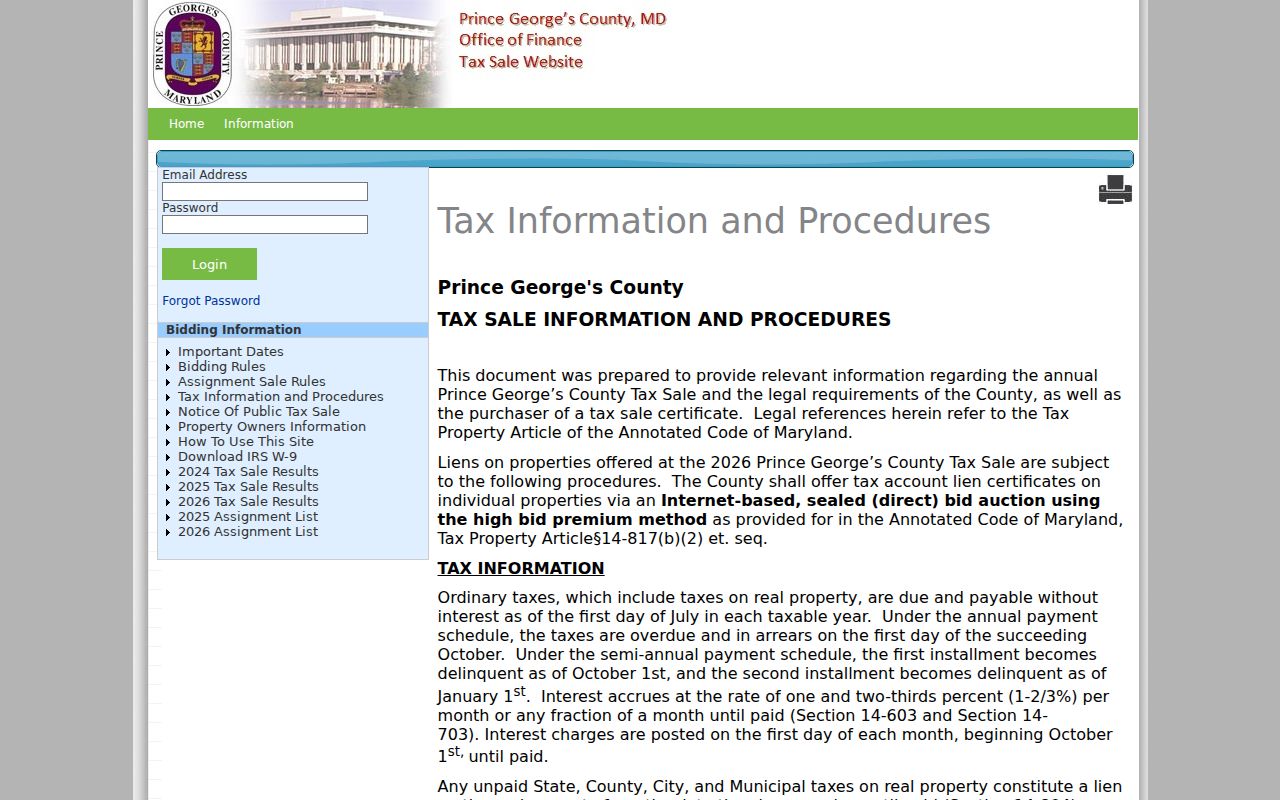
The official tax-sale property list can be searched several ways. Use account number, batch, city, assessed-value range, or sort choice. Results may include parcel ID and sequence. District, account name and address, land area, and improvements can also appear. Legal information, assessed value, and taxes round out the entry. Those fields help match a listed account to SDAT and the deed. A listing does not transfer title by itself. The 2026 notice says property is sold as-is and clear title is not guaranteed. Check annual thresholds and redemption terms against the current notice before relying on anything. Review the current county tax-sale information on the county's official page.
The notice sets collection status and sale procedure. For a later transfer of title, the land record remains the source.
Match Prince George's County Tax Accounts
Match a result by account and parcel, never by city name alone. A mailing city field or ZIP code proves nothing about municipal limits. The legal description, map, parcel, land area, and SDAT account form a far stronger match near Bowie, College Park, or Laurel boundaries.
| Match Key | Reason | Cross-check |
|---|---|---|
| Account number | Links bill and assessment | SDAT report |
| Parcel and district | Separates similar addresses | PGAtlas |
| Legal description | Names land in record terms | Deed and plat |
| Land and improvements | Checks value components | SDAT fields |
This check keeps one parcel's delinquency from attaching to another with a similar street label. It also explains why an account's mailing address may differ from its premises address.
Prince George's County Reassessment Cycle
Maryland reassesses real property on a three-year cycle. Prince George's County parcels follow that same schedule. New construction can trigger an out-of-cycle assessment. One parcel's records may show several figures at once. A prior assessment, a current full cash value, a phase-in figure, and a later tax bill can sit side by side in a single account. Each figure carries its own source date. Keep those dates straight or the numbers stop making sense.
A recent sale does not force the assessment to match the deed price. Deed consideration can cover multiple accounts. It can also reflect a transfer that was not an ordinary arm's-length sale. An exemption or phase-in amount shifts the tax base. The price in the deed records stays put.
Note: SDAT's sale Price field is deed consideration. It may span multiple accounts, so it is not always a comparable sale.
Challenge a Prince George's County Assessment
Maryland gives owners three appeal levels. The first is the SDAT supervisor, then the Property Tax Assessment Appeal Board, and finally the Maryland Tax Court. Your assessment notice prints the filing date that controls the first step. No single calendar date governs every notice. Follow the deadline on your own document. The SDAT assessment appeal process page carries the current forms.
Good evidence fits the valuation date. That might be a corrected parcel description, comparable sales, photos, or repair facts. Remember the appeal contests value only. A question about a paid balance or a county charge belongs with Finance, not the appeal.
Appeal window. File by the date printed on the Maryland notice and preserve proof of filing; later review levels have separate deadlines.
Request Prince George's County Tax Records
Online access is only one channel. County Finance is the custodian for bill and payment questions. SDAT handles the assessment record. A deed-copy question goes to the land-record system, not the tax desk. Give staff the premises address, account, tax year, record sought, and preferred format. That helps them pull the right file.
A tax or assessment item may not be online. The Maryland Public Information Act route then starts with the office that holds it. The county request hub explains how to submit a focused request. County materials say the first two search hours are free. Later search, preparation, and copy charges may apply. County guidance allows up to 30 days for a response.
Ask for an existing record, not an explanation the agency must create. Useful terms include the account number, property address, bill year, and charge type. Also note any payment entry, delinquency notice, or tax-sale notice. Preserve the response and any fee estimate with the rest of your parcel file.
Reconcile Prince George's County Tax Dates
A complete tax history keeps several dates separate. The assessment date and bill year each matter. So do the due date and payment date. The delinquency date, advertisement period, and tax-sale event do too. Each tells a different part of the story. Separating them keeps the record clean. It prevents a later payment from looking like proof that the earlier bill was never delinquent. It also stops a tax-sale list from being read as proof that title changed.
Match every entry to its account number and legal parcel. Check MDLandRec for any deed or release that followed. County tax records explain the debt and collection path, while recorded instruments explain ownership. Court Case Search can offer a lead. This helps when a lien or title dispute went to litigation. Its online summary is not the full file, though.
Older bills or support records may need direct contact with Finance. Ask for a specific year and type. A focused request is easier to search. It is also less likely to return a similar account by mistake.