
What Prince George's Deeds Record
A recorded deed does several jobs at once. It identifies the grantor and grantee, describes the property, states the consideration when reported, and places the conveyance in the public land-record chain. Prince George's County deed records may also point to a subdivision plat, an easement, a restriction, or a prior instrument. Trust the legal description over a familiar address. Addresses change. The recorded chain follows the land itself, and the prior-deed clause keeps each deed anchored to the parcel.
| Instrument | Recorded effect | Typical context |
|---|---|---|
| Warranty deed | Conveys the stated interest with title promises written into the instrument | An ordinary sale |
| Quitclaim deed | Conveys whatever interest the grantor has without a broad title warranty | Family or ownership cleanup |
| Trustee or representative deed | Transfers through an authorized fiduciary | Trust, estate, or court-directed transaction |
| Deed of trust | Secures a debt against the land rather than conveying the buyer's title | Mortgage financing |
| Release or assignment | Changes or clears a recorded security interest | Loan payoff or transfer |
Not every indexed instrument conveys ownership. A deed of trust, assignment, release, lien, agreement, or notice can affect the land without transferring fee title. The instrument image and party roles settle that. Maryland also keeps land records separate from the county tax bill and from SDAT's assessment summary.
Prince George's MDLandRec Fields
MDLandRec provides free index and image access after account registration and multifactor authentication. Start with Prince George's County. Use the least restrictive name and date terms that distinguish the party. Entity names belong in the corporation route. Personal names belong in the individual route. The newer text controls help recover spelling variants. But broad Soundex results can be capped.
| Search control | Useful choice | Why it matters |
|---|---|---|
| Party name | Last, first, middle, suffix | Separates people with similar names |
| Party type | Grantor, grantee, or all | Distinguishes giving from receiving title |
| Ownership | Individual or corporation | Routes LLC and institutional deeds correctly |
| Document and date | Type plus all, exact, before, after, or on | Narrows a long party history |
| Text modifier | Begins With, Contains, Fuzzy, Soundex | Finds name and spelling variants |
| Reference | Book and page | Jumps directly from an SDAT deed citation |
Each result lists the recorded date, grantor and grantee, instrument type, book and page, remarks, and links to details or an image. Electronically indexed instruments may deliver a whole PDF. Older records may expose one page at a time. The book-and-page viewer then allows only a limited page range.
Opening Prince George's Deed Images
The official MDLandRec usage instructions cover indexes, marked lists, and image links.
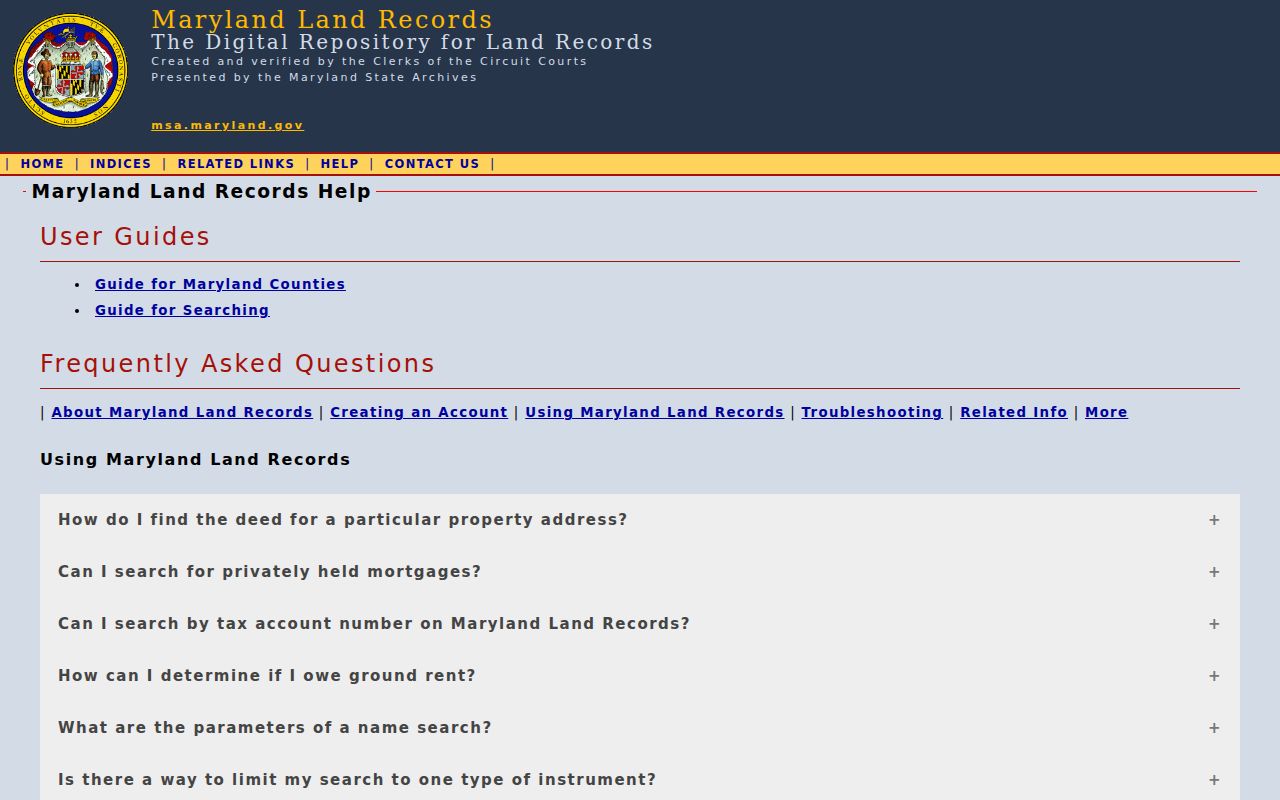
A single page is not the whole instrument. Turn to the help screen when that happens. Check the deed's page count, then continue through every page so signatures, legal descriptions, exhibits, and prior-record references are not missed.
Trace a Prince George's Title Chain
The grantor transfers an interest; the grantee receives it. A chain of title is the ordered line of recorded conveyances tied to the same land. Maryland calls the book-and-page reference liber and folio. That citation locates the instrument in the record books. These terms turn a list of names into a reproducible deed trail.
- Find the newest deed by using SDAT's Liber/Folio reference or searching the current owner as grantee.
- Open the full image and record its legal description, grantor, grantee, date, and prior-deed clause.
- Jump to the cited prior book and page, or search that grantor as an earlier grantee.
- Repeat while the legal description, lot, tract, and plat references continue to match.
- Move to archive indexes and deed books when an electronic search no longer reaches the needed period.
Name matching alone is risky. Initials, punctuation, marital abbreviations, trusts, estates, and entities can all shift between transfers. Compare the land description at every step. When a deed lacks a prior reference, broaden the seller's grantee search and test spelling variants rather than attaching an unrelated same-name deed.
The Prince George's CE411 Exception
Prince George's County has a separate indexing rule. Agreements, Assignments, Notices, and Releases dated 1966 through 1994 sit in the CE411 index, which alone can explain an apparent gap. Before 1966, releases differ. A release from that era may appear only on the instrument itself, and the ordinary deed path stops there. A search confined to that path can miss a document that changes a mortgage or another recorded interest.
Time the check carefully. It works best after the main conveyance is identified, so note the secured party, borrower, book and page, and recording date. Then test CE411. A missing hit proves nothing about the debt. It only means the instrument and the applicable historical index deserve inspection before any conclusion.
Historic Prince George's Deed Books
Prince George's land-record series begin in 1696. CE21 spans 1696 through 1840, and CE22 continues from 1840 through 1884. CM769 carries 1696 through 1851 on microfilm. The C1240 index spans 1851 through 1924, and grantor index CM773 covers 1884 through 1949. The C2381 plat series, with related plats-from-land-records material, helps connect lots and tracts to those books.
No single cutoff promises that every older deed is electronically indexed. That gap should shape the search. When the web portal falls silent, try other paths. Use the Archives land-record series guide, courthouse terminals, microfilm, and paper indexes. Abstracts for 1787 through 1802 provide another early fallback. Pre-1704 patented certificates and tract surveys may be incomplete because of historic losses.
Historic coverage describes surviving series, not a promise that every instrument or image is available online.
From SDAT to the Recorded Deed
SDAT's Real Property Search is the easiest bridge into Prince George's County deed records. The Owner Name field reflects the name on the most recent recorded deed. It usually sits on the first line. Liber/Folio gives you the recorded reference. Mailing Address and Premises Address each mean something different. Neither one proves an owner's residence.
Copy the owner label character for character. That includes abbreviations like ET AL, ET UX, T/E, or /WF. Then pull the liber and folio into MDLandRec to open the deed itself. SDAT maintains its database daily, yet the official material promises no fixed update interval after recording. When a sale is recent, the newest recorded conveyance is still the safer source for Prince George's County property records.
Estate Transfers in Prince George's
An estate can break a clean buyer-to-seller chain. SDAT may still list a decedent. Meanwhile the Register of Wills file names a personal representative instead. Run the case through Estate Search. Then check MDLandRec for an executor, administrator, trustee, or representative deed. Keep two points straight. The representative is not automatically the owner, and an inventory alone transfers nothing.
For a sound chain, read the probate docket beside the later recorded instrument. Save the estate number. Also save the death and filing dates, the representative's name, and any aliases. Keep each inventory or Information Report reference to real property. This route earns its keep in heir research. It explains why the person managing a property can differ from the owner of record on the tax roll. That gap surprises many people tracing Prince George's County deed records.
Obtain a Prince George's Deed Copy
Online images are free once you register for MDLandRec and complete MFA. Courthouse terminals offer another route if account or image problems block the portal. Maryland State Archives also takes deed and land-record orders by form. The form asks for the property address, grantor, grantee, sale date, optional book/page, copy quantity, contact and shipping details. It also asks for payment. Regular hard copies carry a general fee reference of 50 cents per page. Confirm certification and shipping charges before you order.
Prince George's County points deed-copy questions to 301-780-2253. Have the exact book/page and party names ready when you can. A plain image often suffices for personal research. A transaction, court filing, or other formal use may call for a certified copy instead. Clerks supply records. They do not offer a legal title opinion. That applies to any deed in the county's land records.
Recorded evidence has limits. The index reports instruments accepted for recording. It does not rule out indexing errors, unrecorded interests, or defects that require a professional title examination.