
Prince George's Former Owner Timeline
Open a transfer worksheet first. Each row should hold one matched conveyance. Dates alone never prove a match, and a renamed road, split tract, subdivision plat, or changed account can quietly break an address-only search, so the worksheet must show why every deed belongs to the same parcel.
| Transfer date | Grantor to grantee | Instrument | Book/page |
|---|---|---|---|
| Newest recorded date | Seller to present grantee | Current deed | SDAT Liber/Folio |
| Prior recorded date | Earlier seller to later seller | Acquisition deed | Prior-deed clause |
| Earlier book date | Historic grantor to grantee | Deed-book entry | Archive or microfilm citation |
| Subdivision date | Developer or tract owner | Plat and related deed | Plat book/page |
Three systems carry the chain. SDAT supplies a recent deed reference. MDLandRec carries the recorded instruments, and MSA's historic indexes reach Prince George's earliest land records; any example table here is a model for notes, not a claim about a private parcel.
Walk Prince George's Deeds Backward
A grantor transfers an interest; a grantee receives it. That pairing repeats through every conveyance in the chain of title. The legal description, naming the tract, lot, block, or parcel in recorded terms, is what ties each instrument to the same land. It far outlasts a street address.
- Copy the current SDAT Owner Name, parcel details, and Liber/Folio.
- Open that deed and record the grantor, grantee, legal description, plat, and prior reference.
- Jump to the prior book/page or search the grantor as a former grantee.
- Compare land descriptions before adding the transfer to the chain.
- Continue in archive indexes and deed books when the electronic trail stops.
- Grantor / grantee
- The transferring and receiving parties.
- Chain of title
- The ordered line of recorded property transfers.
- Reverse index
- An index route used to find when a named buyer acquired land.
- Quitclaim / warranty
- A transfer of existing interest without broad promises versus a deed carrying stated title warranties.
MDLandRec and Previous Owners
MDLandRec anchors the whole search. It is free with an account and MFA. The MDLandRec indexes and page images can be searched by individual or corporation, party role, document type, date, and name modifiers, and each result shows the recording date, parties, instrument, book and page, remarks, and image links. Try the prior-deed reference first. It ties one instrument to the next. When no reference appears, run the seller as grantee and test Begins With, Contains, Fuzzy, or Soundex. Soundex can return up to 5,000 hits, so add a date or document type and keep name abbreviations and entity suffixes exactly as recorded.
Open Prince George's Historic Images
The official MDLandRec instructions explain electronic indexes, marked lists, book-and-page jumps, and image access.
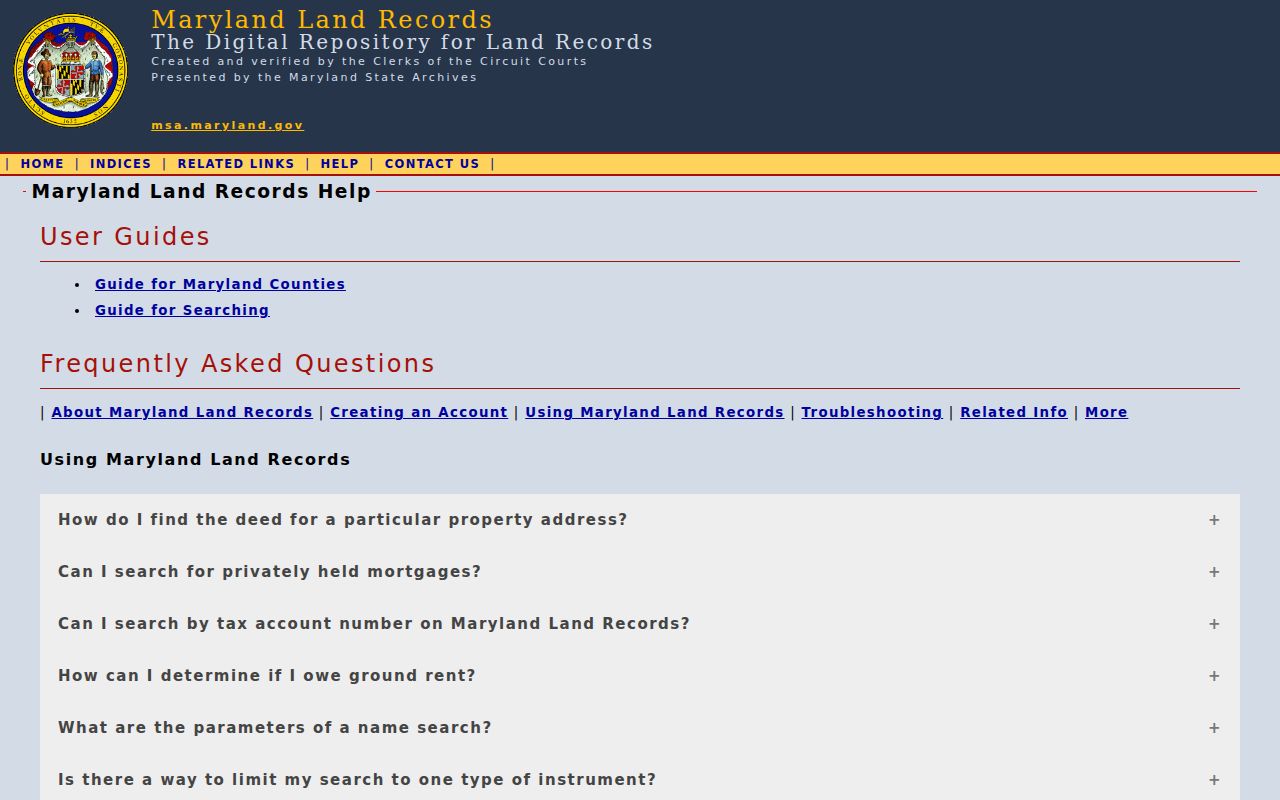
Page images can hide real evidence. Some records open as a full instrument, while others expose images one at a time, so review every page for exhibits, signatures, and the prior-record clause before stepping backward.
Prince George's Ownership Before Digital Records
Prince George's land records begin in 1696. The Maryland State Archives lists several historic series. CE21 spans 1696 to 1840, microfilm series CM769 runs 1696 to 1851, and CE22 covers 1840 to 1884. C1240 indexes 1851 to 1924. CM773 is a grantor index for 1884 to 1949, and plat series C2381 with related material ties subdivisions and lot lines to the deed trail. No exact cutoff is guaranteed. Not every historic instrument sits in the electronic index, so for earlier former owners use courthouse terminals, paper or microfilm indexes, and the MSA series guide. Abstracts from 1787 to 1802 bridge the early gap. Some pre-1704 patented certificates and tract surveys are incomplete because of historic losses.
No single online cutoff. Treat a failed portal search as a cue to change index or format, not proof that no earlier owner existed.
CE411 and Prince George's Chains
Prince George's County kept a separate CE411 index. It covers Agreements, Assignments, Notices, and Releases from 1966 through 1994. Before 1966, a release may be indexed only on the instrument itself. That local quirk explains a missing mortgage-related record. These papers rarely name a new owner, but they can show how an interest was assigned, modified, or released between conveyances. Do not label them title transfers. File them alongside the deed timeline instead.
Plats Reconnect Former Bowie-Era Parcels
A subdivision plat can link a present lot to a developer's larger tract. The trick shines in postwar Bowie communities. Belair and Pointer Ridge are prime examples. The method works across Prince George's County, though. Pull the plat reference from the deed, search the MSA plats system, and compare lot, block, roads, and common areas. PGAtlas geometry helps with current orientation. It is not a survey, and it can link one polygon to several SDAT accounts. Keep both the old tract wording and the current parcel identity rather than forcing one into the other's format.
Estate Transfers and Prior Owners
The Register of Wills explains gaps between an owner's death and a later deed. Estate Search covers 1998 to the present. It includes party and docket clues. A personal representative may sign the later deed, though probate papers alone never make that person the owner of record. Note the estate number, filing and death dates, representative, aliases, and any real-property inventory clue. Then search MDLandRec for the representative deed. It keeps probate authority distinct from the conveyance itself.
Local Clues for Prince George's Past Owners
The Prince George's Room at the county library holds newspapers, vertical files, maps, and community history. Search by street, subdivision, developer, or tract. Those sources can explain an old road name. Tax-sale notices and civic association files may reveal a development campaign that predates the modern parcel account. A newspaper mention is only a lead. Directory entries are the same. Carry every lot, tract, acreage, and party name back to the deed and plat, because this human layer enriches a house history without confusing former occupants with former owners.
Limits of Prince George's Owner History
Older Prince George's County records have real limits. Some patented certificates, surveys, and deed index entries never survived, and many that did survive have never appeared online. Street names and account numbers change too. Claim only what the documents prove. State the earliest confirmed deed in the chain rather than naming an original owner without patent evidence. Recorded deeds also list legal parties, not every occupant. Tax rolls, newspapers, probate files, and directories can add context, though each source deserves its own label and date, and a full title opinion still calls for professional work beyond a personal history search.
Lawful use. Former-owner research supports house history, estate work, and property diligence. Never use historic or current owner data to track, threaten, or harass a living person.
Audit a Prince George's Deed Chain
Treat any owner list with doubt. Test every transition before calling it a chain. The prior grantee should match the later grantor. Name changes or legal roles are exceptions. Lot, tract, acreage, and plat details should stay consistent. Otherwise, show a recorded split, consolidation, or correction. Dates should make sense, though recording can lag behind execution. Mark uncertain links. A same-name party, shared street, or similar acreage is not enough to prove a connection. When a road, account, or subdivision name changed, keep both versions. Cite the Prince George's County record that links them, which keeps former owners distinct from mere occupants.